Your MSP Service is a Product – Here’s How to Start Deliver Business Results

Here’s the hard truth most MSPs don’t want to hear: your service isn’t special.
It’s not because you don’t work hard. Or because your tech stack isn’t solid. Or even because your customer service isn’t top-notch.
It’s because your clients don’t want IT.
They don’t wake up in the morning excited to pay for managed services. They’re not thinking, “Wow, I hope my MSP bills me more this month!” In fact, most of them don’t even understand what you do — worse, they don’t care to.
And here’s where it gets real: the market is shifting. Fast.
Services are becoming invisible. Clients expect uptime, security, access, and performance as a given — like electricity or running water. And just like with plumbing, they only notice when something breaks.
That’s why MSPs who keep selling “IT support” are being swallowed up by commoditization, price pressure, and constant firefighting.
And it’s why MSPs are developing business solutions, becoming business solution providers, rather than selling tech infrastructure.
Stop selling services. Start delivering a product.
We’re not talking about turning your MSP into a Best Buy. This isn’t about selling hardware, or well, it could be about selling hardware, but that’s not the point. It’s about packaging your expertise, outcomes, and value into something tangible — something clients can understand and value.
Just ask Will from F1IT. When he first joined our program, he was stuck in survival mode — juggling client fires, working late nights, barely pulling in $280K a year. His “services” were solid, but his business was invisible to clients. They didn’t see his value.
Productizing his offer — not by changing the tech, but by changing how he talked about it, packaged it, and priced it, opened up a whole new way to sell and relate to his clients.
In less than a year, Will doubled his revenue. In two he was over a million.
The key change was the shift from “IT support” to selling a solution with a name, a clear outcome, and a price that reflected its true value.
In this post, you’ll learn how to do the same. We’ll break down:
Why price isn’t the problem (even when it feels like it is)
How to define the real product you’re selling
And how to use our Product Design Sheet to build something scalable and sellable
Let’s get into it.
Price isn’t the problem
We hear from MSPs all the time that believe they are facing extreme price pressure and then lose clients to MSPs selling at a higher price.
If you are selling IT support, cybersecurity, or some mix of technical services. But here’s the reality:
Your clients are not buying what you think you’re selling
When you lead with service descriptions — hours of support, ticket response times, remote monitoring — you’re reducing yourself to effort, rather than value. It’s nearly impossible for a non-technical business owner to understand the value.
They look at the bottom line as a cost and ask, logically, how can we make this cheaper.
It’s like mattress shopping.
One store says, “This model includes 3,000 micro coils, gel foam, and a breathable bamboo cover.” The other says, “This mattress gives you the best night’s sleep of your life — guaranteed.”
Which one sounds more valuable?
Your job isn’t to sell IT. It’s to sell business solutions. When you do, you’ll discover that price doesn’t matter.
And the first step in doing that is turning your service into a product.
The Productization Process: Turn Services into Scalable Business solutions
Productization is transforms your services into structured, outcome-driven offers that clients can understand, trust, and confidently invest in.
It’s not about changing what you do — it’s about changing how you present it.
At Start Grow Manage, we use a three-step process to help MSPs do just that. It’s called the Product Design Sheet, and it guides you through turning your invisible service into a concrete, compelling product.
Here’s the structure:
Step 1: Identify Your Value
Forget hours, tickets, and tools — start with the outcome.
What are the problems you solve for your clients? What are they really buying from you?
Peace of mind? Productivity? Risk reduction? Growth?
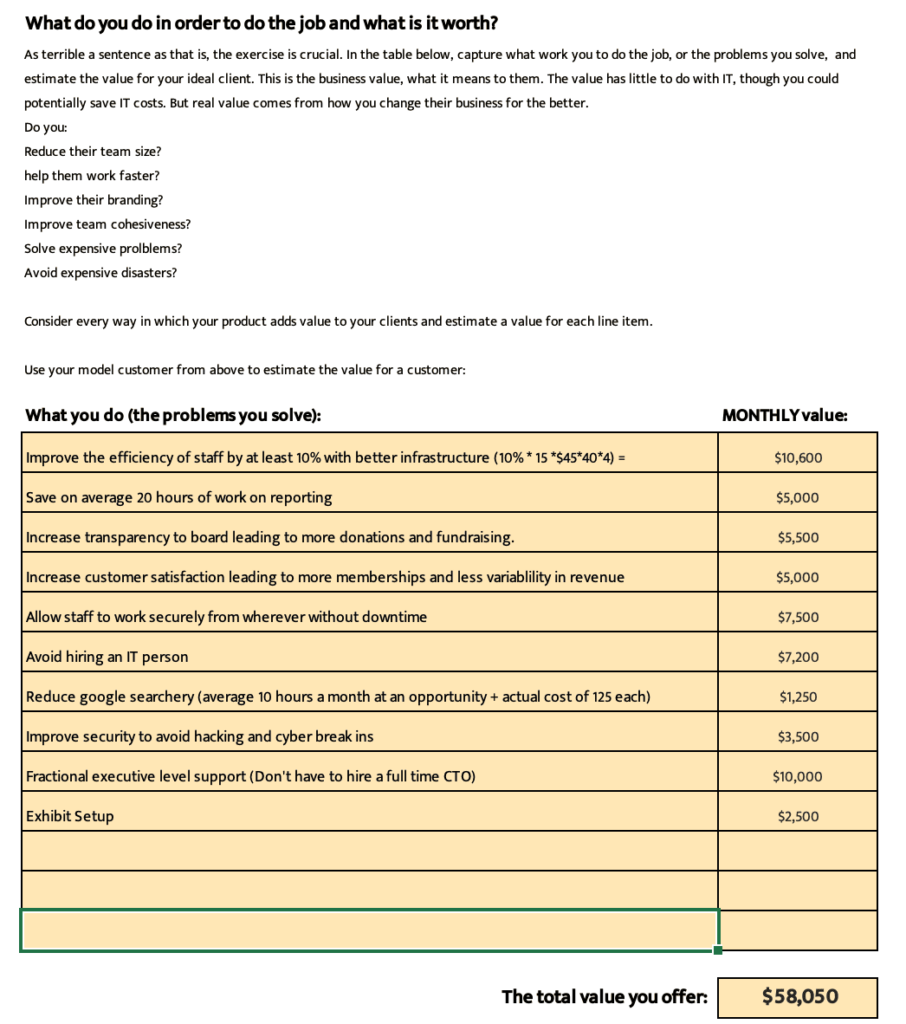
The first step is getting clear on the transformation you deliver—not the tasks, not the effort, but the result, and assessing its value. This is the hardest part, and it involves guessing and estimates, but it is crucial to understanding and communicating your value.
This becomes the foundation of your product — the promise you’re making to your market.
When you think about your value you come up with something like this (from our Product Design Workbook):
Step 2: Define Your Stack
Once you know the value, you can build your stack — the components that make the result happen.
Your stack should be standardized, repeatable, and easy to explain. Yes, it’s the same stack and the same solution every time. Your customers buy what you are selling, you don’t adjust to their desires.
I’ve heard some MSPs mock this “we don’t do a cookie-cutter approach,” which is fine, but they are all small, overworked, and looking for a solution.
And ideally, your product comes in named packages (like “Business Continuity Suite” or “Productivity Accelerator”) that differentiate you from every other “support provider” in town.
George at Biztech, for example, doesn’t sell “cybersecurity,” he sells “DermProtect,” because he works with Dermatologists – he makes it about them.
As you define your stack, you assess your cost. You must know your cost to ensure your pricing makes you money.
Designing your product should look something like this (taken from our Product Design Workbook):
Step 3: Set Your Price
Now that you know your product and your value you calculate your price.
At a minimum, your price should be 3 times your direct cost (the cost you calculated in the product design sheet). Businesses don’t survive on less. The rule of thumb is that a third of revenue goes to direct cost, a third goes to overhead, and a third goes to client acquisition.
Over time, you get better at delivery and client acquisition, so all your costs go down, but your price doesn’t. That’s how you make more profit.
The maximum price you can charge is the value you deliver. Though, we normally work with 1/3 of the value to make your offer ridiculously valuable. So, your price is between 3x cost and 1/3 of value.
You adjust this by measuring competitive pressure (often MUCH less than you think, once you’ve productized), and the quality level of your service (high-medium-low, sometimes you start low and get better over time).
Bring these together to assess what your price should be (taken from our product design workbook):
(Interested in learning how to define value for your MSP? Check out the Accelerator, we’ll show you how.)
The End Game: Freedom, Focus, and Real Growth
When you productize, everything changes.
You stop customizing your business around every client request. You stop competing on price. You stop working harder just to keep up.
Instead, you start building something repeatable. Scalable. Valuable.
You reclaim your time. You create clarity for your team. You attract clients who want what you offer — and are happy to pay or it.
This is what we mean when we say “stop selling services, start delivering results.” It’s not just a mindset shift — it’s a business model transformation.
It’s how owners like Will and George stopped spinning their wheels and built businesses that grow with less effort, more impact, and zero 2 a.m. emergencies.
And it’s how you move from overworked technician to strategic CEO — the kind of business leader who leads the company instead of carrying it on their back.
If you’re ready to explore what that looks like in your MSP then:
Let’s Build Your Product Together
Want to see what this could look like for your business?
Our program is designed to help you create a scalable business machine, Our programs like Double Your Sales without added work and the MSP Accelerator will get you to the next stage of your journey.
But it isn’t for everybody, so if you want to see what might be next for you,
Book a Demo with Start Grow Manage
And we can figure it out.
This isn’t about theory — it’s about implementation. We’ll look at your current service, identify where value is hidden, and help you reframe it as a product your clients will actually want to buy.
The future isn’t more tech. It’s better business. Let’s get started.